How long do bacteria live in dog poop?
The pathogens that linger, and the disinfectants that actually work.
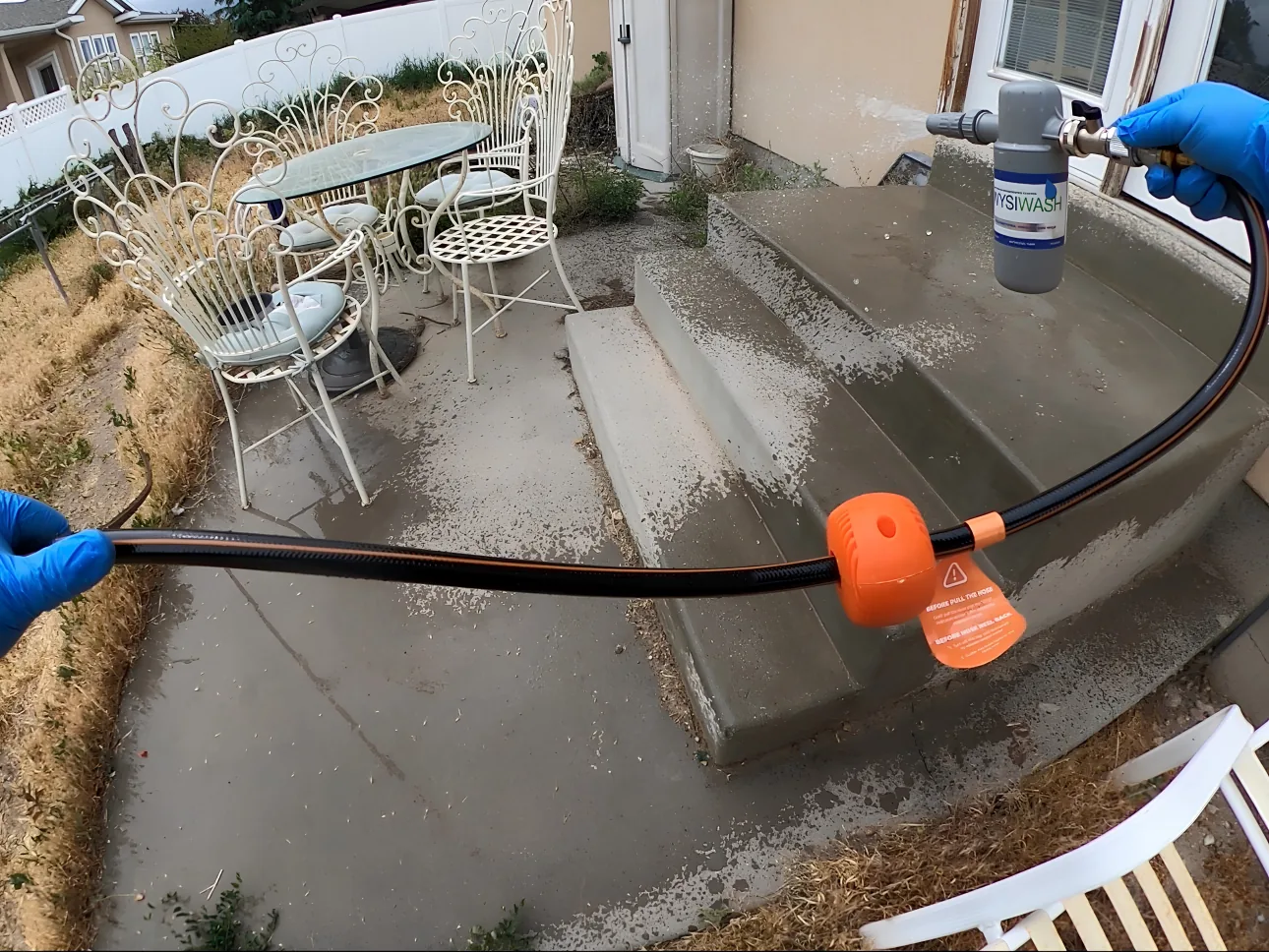
Most yard sanitizers advertised to dog owners are either too harsh to use on grass or too mild to do anything meaningful to a real pathogen. Wysiwash sits in a rare middle: genuine EPA-registered kill rates against E. coli, Salmonella, Staph, and the fecal bacteria your family is most likely to encounter, on both hard surfaces and grass, yet gentle enough to apply across the entire yard, paws and all. Here is exactly what it does and does not do.
Here's how it actually works, why we chose it, and what to expect from a treatment.
Wysiwash is a closed-loop sanitation system used by shelters, humane societies, kennels, and veterinary clinics across the country. The hardware is a hose-end injector. The consumable is a small calcium hypochlorite caplet. When water flows through the unit, it dissolves the caplet into a precisely-mixed hypochlorous acid (HOCl) solution at sanitizing strength.
That on-site generation matters. Hypochlorous acid loses potency in storage. Bottled "HOCl sprays" sold online are often half-strength by the time they arrive. Generated fresh at the hose, it's at full sanitizing concentration when it hits the yard.
Hypochlorous acid is the same molecule your immune system makes when white blood cells attack pathogens. In the body, it neutralizes invaders within milliseconds. At sanitizing strength outside the body, it does roughly the same thing: it penetrates the cell wall of bacteria, viruses, and protozoa, then disrupts their internal proteins so they can no longer replicate.
Mechanism aside, the practical advantages over bleach and other disinfectants:
"It's the rare product that works in the lab, in the field, and on the lawn, without forcing us to choose between any two of them."
Why we standardized on WysiwashThis is the question we get most often, and the answer is reassuringly boring. At the concentrations Wysiwash delivers (around 200 ppm available chlorine, mostly as hypochlorous acid):
Non-toxic if licked from grass after a brief dry-down. Won't burn paws. Won't stain or yellow lawns. Won't kill beneficial soil microbes when used at recommended intervals. Approved for use in food-production environments. Dogs typically return to the yard within 10 to 15 minutes of application.
The other side of "safe": it's also gentle enough that it doesn't over-sanitize. Lawns rely on a healthy soil microbiome. Anything that wipes the soil clean wipes out the good bacteria with the bad. Wysiwash sanitizes surfaces where bacteria and pathogens linger. On hard surfaces it achieves complete kill of viruses and protozoa. On grass it meaningfully reduces bacterial load without poisoning the soil below it.
No disinfectant works on a yard that still has piles in it. We complete the Double-Walk Grid Method, two-axis coverage, before any sanitizer touches the ground.
Mixed on-site to ensure full-strength solution. We treat the entire yard, hard surfaces and grass alike. The bacterial protection is real across both. Parvo and Giardia control is targeted at hard surfaces specifically.
Patios, kennel runs, shaded corners, and hard surface hotspots get an additional treatment. Hard surfaces are where complete pathogen kill is achievable, including parvo and Giardia with full dwell time.
Most yards are dog-safe within 10 to 15 minutes of finishing. We send a gate photo when we close up so you know the work is done.
Wysiwash performs differently on different surface types. The table below notes where each kill claim applies. Hard surface claims are EPA-registered. Grass surface claims reflect meaningful reduction, not complete elimination.
| Pathogen | Contact kill time | Surfaces | Notes |
|---|---|---|---|
| Canine parvovirus | 60 sec | Hard surfaces only | EPA-registered on non-porous surfaces. Hypochlorous acid is neutralized by organic matter on grass and soil. Parvo on organic surfaces requires Virkon-S protocol. |
| Giardia cysts | 60 sec | Hard surfaces only | Effective at proper dwell time on non-porous surfaces. Not reliably effective on grass or soil. |
| Salmonella | 30 sec | Hard surfaces + grass | Including drug-resistant strains. Meaningful kill on grass confirmed. Bacteria are significantly more susceptible to HOCl than viruses. |
| E. coli | 30 sec | Hard surfaces + grass | All major pathogenic strains. The primary bacterial threat to kids and pets from dog waste. |
| Bordetella (kennel cough) | 60 sec | Hard surfaces + grass | Important in multi-dog households. |
| Distemper virus | 60 sec | Hard surfaces only | Less common but relevant for puppies. Hard surface claim only. |
| Common fungal spores | 2 to 10 min | Hard surfaces + grass | Including ringworm carriers. Surface fungi are susceptible to HOCl on both surface types. |
| Staph and Strep | 30 sec | Hard surfaces + grass | Fecal bacteria that accumulate from dog waste. Real reduction on grass surfaces. |
Hard surface claims are based on EPA registration and manufacturer kill-time data. Grass/soil bacterial reduction is supported by independent research on calcium hypochlorite efficacy against enteric bacteria on organic surfaces. Complete viral elimination on organic surfaces is not claimed and is not achievable by any product.
What it doesn't reliably kill on organic surfaces: parvovirus, Giardia cysts, and hardened parasite eggs in soil (roundworm, hookworm). For parasite eggs, physical removal is the answer, and the reason we never skip the waste-removal pass. For parvo decontamination of organic surfaces following a confirmed diagnosis, a different protocol using Virkon-S is required. See our BioReset decontamination service.
Frequency depends on the household:
You don't have to think about bacteria, contact times, or which surfaces need what product. We know the difference, and we apply the right chemistry in the right places every visit. We serve Utah County and Salt Lake County.
 Yard wellness
The pathogens that linger, and the disinfectants that actually work.
 Yard wellness
A month-by-month decontamination playbook for the next dog.
 Pet safety
The yard hazards every Utah dog owner should be able to identify.
Weekly visits. Hospital-grade sanitation. Trained eyes on every pile, every yard, every visit. Backed by the Double Guarantee.